
The Kya Project

20
Jul 2026
Read More


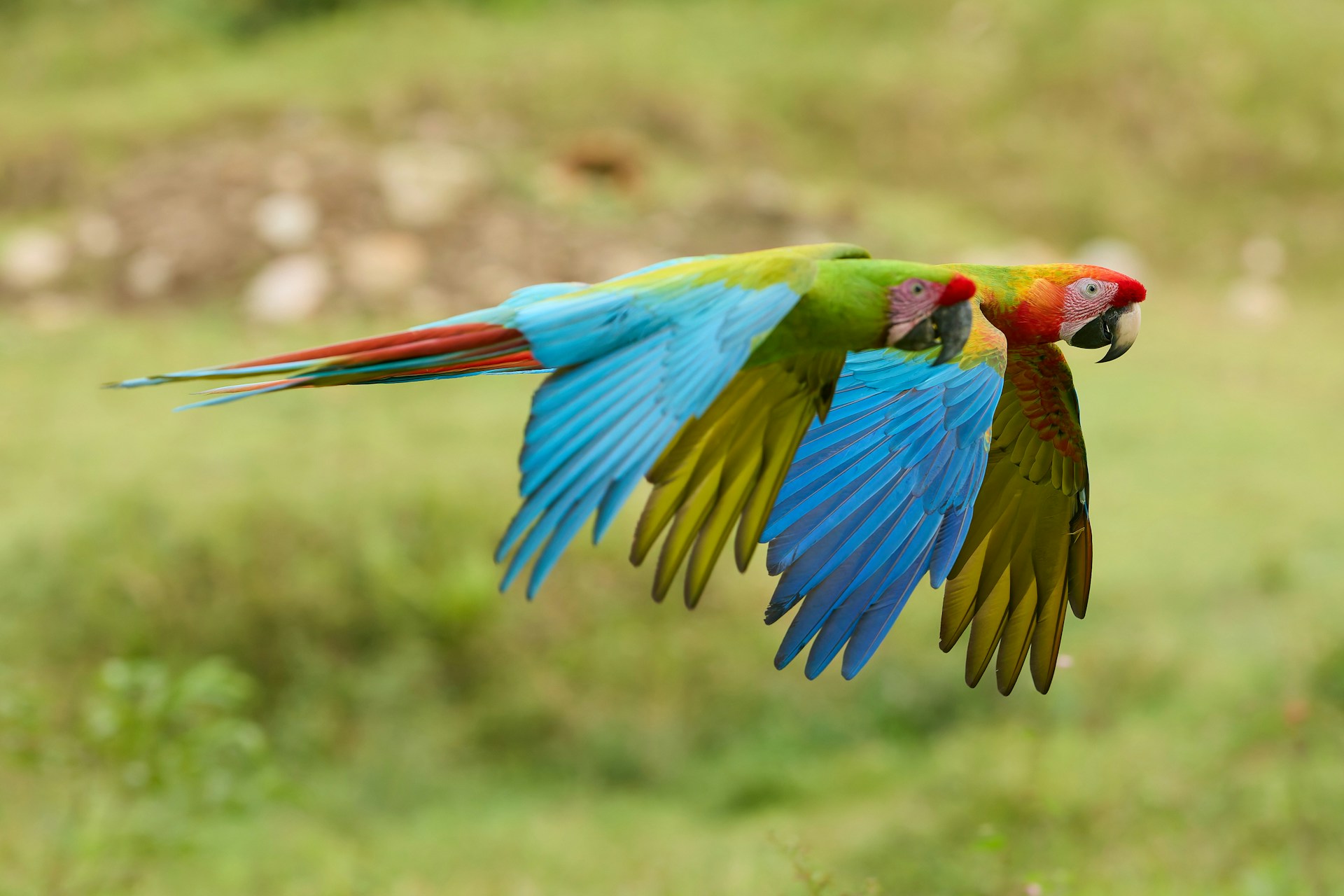
In a long-term behavioral project by Constance Woodman, Chris Biro, and Donald J. Brightsmith, researchers followed captive-raised parrots learning to fly outdoors in gradually more complex environments to understand a conservation problem: why released parrots so often fail in the wild. Instead of teaching survival behaviors directly, the team focused on development — giving birds staged experiences that let natural abilities emerge. You can read the complete study in the original paper.
Most advice around free-flight focuses on reliability. Strong recall, strong bonding, strong responsiveness. The assumption underneath is straightforward: once a bird performs trained behaviors consistently enough, the outside world becomes manageable.
The study takes a different angle. The birds that succeed outdoors are not the ones that obey best — they are the ones that recognize situations fastest.
Many released parrots fail despite flying well and responding to handlers. They separate from flocks, panic at harmless movement, ignore real predators, or disperse unpredictably. These are not mechanical problems and not really obedience problems either. They are interpretation problems. The bird encounters a combination of distance, motion, visibility, and uncertainty it has never processed before and has to decide in real time.
So the researchers changed the preparation method. Instead of teaching survival behaviors directly, they built a staged learning environment.
Conservation programs have a recurring problem: healthy parrots are released into the wild and still fail. They fly well, eat prepared food well, and respond to handlers, but they struggle to stay with flocks, misread predators, panic in open space, or disperse unpredictably.
The question behind this study was simple:
are those failures caused by missing instinct, or missing experience?
To test that, the researchers raised 37 parrots and did something unusual. Instead of keeping them in aviaries and then releasing them, they created a step-by-step outdoor learning process. The birds progressed through six environmental levels:
The birds could still be recalled during early stages, which allowed exposure without full risk. The goal was not to teach specific reactions but to let the birds repeatedly encounter manageable versions of real situations.
The researchers tracked whether the parrots developed abilities that commonly determine survival after release:
Most release programs try to install these behaviors directly — for example showing predator silhouettes or training specific avoidance responses. This study instead asked whether those abilities appear naturally when the bird gains enough real-world history.
Over more than 500 cumulative months of outdoor flight, the birds changed in consistent ways.
Early flights were unstable. Birds circled widely, hesitated to land, and regrouped constantly. Later flights became organized. Flocks launched together, reacted to alarm calls collectively, and chose safer perching and travel routes.
They also learned discrimination. Harmless animals stopped causing panic. Real predators triggered faster, coordinated escape responses.
The most notable result: despite frequent encounters with hawks and other predators, there were no predation deaths.
Importantly, these outcomes appeared without directly teaching most of the behaviors. They emerged after repeated exposure to solvable challenges.
The study shifts the goal of training. Instead of asking whether the bird performs correctly, you start asking what the bird has already figured out.
A bird can recall perfectly and still panic when the flock splits across trees because it has never practiced resolving partial separation. Another bird with extensive staged exposure often appears calm because the situation matches patterns it has solved before.
Readiness becomes a history rather than a milestone.
So progression changes from performance-based to complexity-based. Instead of waiting for perfect recall before increasing freedom, you increase environmental variation while recall still exists as backup. Support and challenge overlap.
So instead of “graduate” locations, think layered variables:
You also stop using recall as the main activity. Recall protects the learning window, but the learning comes from time spent navigating space voluntarily — distance changes, regrouping, moving stimuli, and brief uncertainty.
In practice this alters how sessions feel:
- You allow small recoverable mistakes rather than preventing all mistakes.
- You introduce new environmental questions instead of repeating known behaviors.
- You watch recovery after surprise rather than only response to cues.
Calm assessment becomes a more meaningful milestone than instant return. A bird pausing to evaluate is building judgment.
Free-flight reliability starts to look less like obedience and more like familiarity. The sky stops being new.
Release programs have historically tried to teach parrots what to do. Avoid predators, stay near the site, follow specific cues. But wild juveniles normally learn through repeated exposure alongside experienced birds, not isolated lessons.
The staged free-flight approach recreates that missing developmental period. The handler temporarily replaces the experienced flock by controlling which situations occur and in what order. Over time the birds rely less on the handler and more on their own interpretation.
This suggests a different release model: experienced “pioneer flocks.” Birds that already understand navigation, group movement, and threat discrimination could help newly released birds learn socially rather than through early mortality. Similar approaches helped raptor reintroduction succeed once falconry methods were incorporated.
The broader implication is that survival depends less on instinct than on accumulated experience before independence.
Free-flight often gets framed as a question of risk management for companion parrots and a question of instinct for conservation parrots. The study points to the same mechanism in both contexts.
Competence forms when uncertainty is introduced gradually enough to be understood.
Preventing all mistakes delays learning.
Overwhelming exposure accelerates failure.
Ordered exposure produces stability.
The birds in the study did not become reliable because they were exceptionally trained. They became reliable because very little in their environment remained unfamiliar.
This paper evaluates whether structured outdoor free-flight can prepare captive-raised parrots for survival in the wild — a long-standing difficulty in parrot conservation. Many release attempts fail even when birds are healthy because captive environments do not develop flock coordination, predator recognition, navigation, or independent foraging. Instead of teaching individual survival behaviors directly, the researchers tested a developmental approach: progressively exposing birds to real environments so the behaviors could form naturally.
Thirty-seven parrots across several species were hand-raised and moved through six increasingly complex environmental levels, beginning indoors and advancing to large natural landscapes containing predators and variable terrain. Early stages emphasized recall and group cohesion. Later stages introduced wildlife, distance travel, and unpredictable conditions while still allowing the birds to return to safety.
Across more than 500 cumulative months of outdoor flight, the parrots developed coordinated flocking, appropriate alarm responses, navigation skills, and use of natural foods. Notably, there were no predation deaths despite frequent encounters with raptors and other predators. Most risks came from human-created hazards such as structures, toxins, and weather exposure rather than ecological threats.
The authors conclude that survival competence is primarily developmental — it emerges from repeated real-world experience rather than instinct alone or isolated training behaviors. They suggest free-flight methods could function as a conservation tool by creating experienced “pioneer flocks” that help newly released birds learn the landscape, similar to how falconry has supported raptor recovery programs.


Stay updated with our charity’s news and see the impact we’re making changes together.



Copyright © The Kya Project